The modern world did not develop through a single event. It emerged from centuries of political, economic, scientific, technological, and social changes. Certain historical events had particularly far-reaching consequences, influencing governments, economies, societies, technology, and international relationships.
The Renaissance
The Renaissance, which began in Europe around the late Middle Ages, encouraged renewed interest in art, science, literature, philosophy, and classical knowledge.
It helped promote intellectual inquiry and contributed to major developments in European culture. Figures associated with Renaissance art and science demonstrated the growing importance of observation, creativity, and human-centered scholarship.
The movement helped establish intellectual foundations that influenced later developments in Europe.
The Age of Exploration
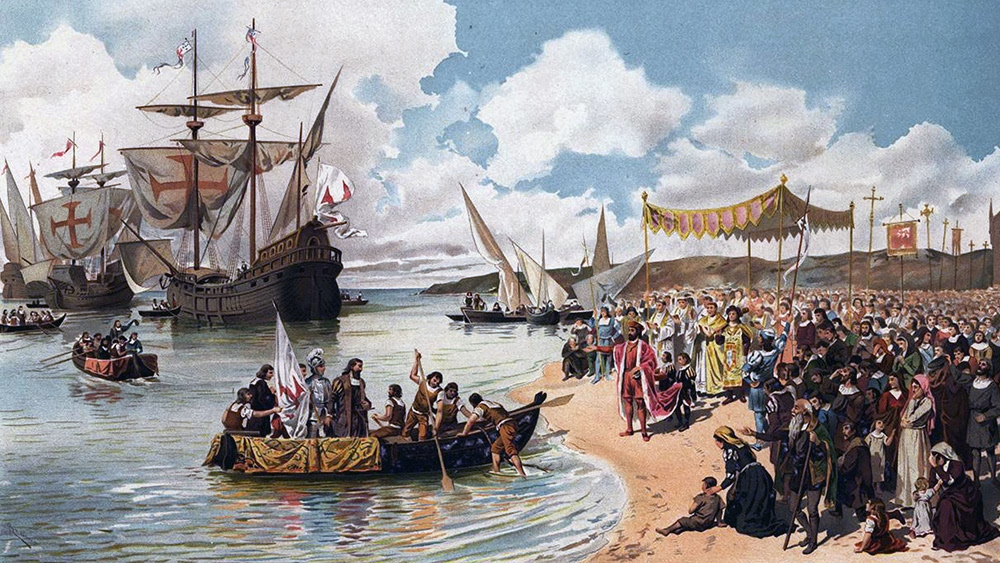
European maritime exploration from the 15th century onward connected previously distant regions through expanding trade and political networks.
These voyages contributed to the exchange of goods, crops, technologies, languages, and ideas. However, they also led to colonization, exploitation, violence, and the displacement of Indigenous populations.
The global connections created during this period had lasting consequences for economics, culture, politics, and international relations.
The Scientific Revolution
The Scientific Revolution transformed how people approached the natural world. Thinkers increasingly emphasized observation, experimentation, mathematics, and evidence.
Developments in astronomy, physics, biology, and other fields challenged established assumptions and encouraged systematic scientific investigation.
This approach eventually contributed to many technological and medical advances that characterize modern society.
The Industrial Revolution
Beginning in Britain during the 18th century and later spreading to other regions, the Industrial Revolution fundamentally changed production.
Factories, machinery, steam power, and improved transportation increased manufacturing capacity and transformed labor.
People increasingly moved from rural areas to growing cities in search of industrial employment. Urbanization, mass production, modern transportation, and new economic systems emerged from this transformation.
The Industrial Revolution laid important foundations for the modern industrial economy.
The American and French Revolutions
The American Revolution and French Revolution contributed to major changes in political thought.
Ideas concerning representative government, citizenship, political rights, and popular sovereignty became increasingly influential.
The French Revolution also challenged traditional systems of monarchy and privilege, while its political and social consequences extended beyond France.
These developments influenced later political movements and debates about government and individual rights.
World War I
World War I, fought from 1914 to 1918, caused enormous human and political consequences.
The conflict contributed to the collapse or transformation of several major empires and changed the political map of Europe and parts of the Middle East.
Its aftermath also created political and economic conditions that contributed to later instability.
World War II
World War II was another major turning point in modern history. The conflict resulted in immense loss of life and widespread destruction.
The war contributed to the emergence of the United States and Soviet Union as major global powers and led to significant changes in international politics.
It also contributed to the establishment of new international institutions and accelerated developments in science and technology.
The Creation of the United Nations
The United Nations was established in 1945 following World War II to promote international cooperation, peace, security, and human rights.
Although the organization faces limitations and political disagreements, it remains an important part of the international system.
Its creation reflected the growing recognition that global challenges often require cooperation between countries.
The Digital Revolution
The development of computers and digital technologies dramatically changed modern society.
Computing moved from specialized institutions into businesses, schools, homes, and eventually smartphones. Digital communication transformed how people work, shop, learn, entertain themselves, and maintain relationships.
The internet further accelerated this transformation by enabling information and communication to move rapidly across borders.
The Rise of the Internet
The widespread adoption of the internet in the late 20th and early 21st centuries created one of the biggest communication transformations in history.
People gained access to global information networks, online marketplaces, digital media, social platforms, and remote communication tools.
The internet has also changed business models, education, journalism, entertainment, and political communication.
Final Thoughts
The modern world is the result of many interconnected historical developments. The Renaissance encouraged new intellectual and cultural thinking, the Scientific Revolution changed approaches to knowledge, and the Industrial Revolution transformed economies and societies.
Political revolutions influenced ideas about government and rights, while the two World Wars reshaped international relations. More recently, computers and the internet have transformed communication and everyday life.
Studying these events is valuable because history provides context for the world people experience today. Understanding how societies changed over time can help us better appreciate modern institutions, technologies, political systems, and global relationships.